Finding fresh drawing ideas for beginners can feel surprisingly hard when you are staring at a blank sketchbook. I have been there too, pencil in hand, ready to draw, but completely unsure where to start. The best way to break that block is to choose simple subjects that use basic shapes, clear outlines, and small details you can build slowly.
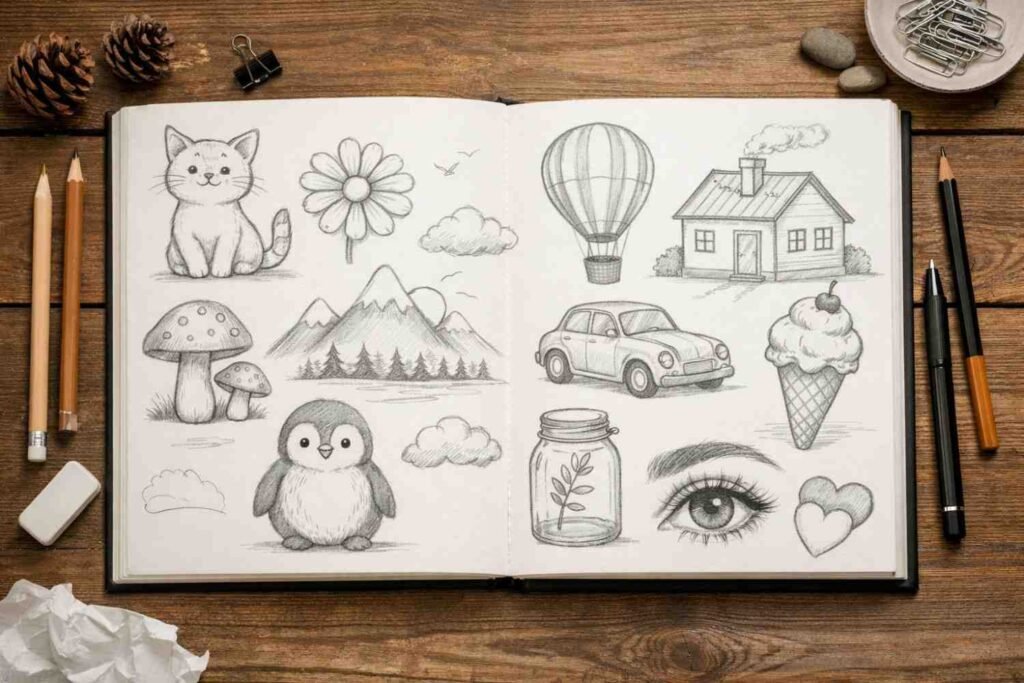
For beginners, everyday objects, nature, plants, food, and whimsical icons work best because they rely on circles, triangles, cylinders, rectangles, ovals, and soft curves. When you learn to see those shapes inside real objects, drawing feels less confusing and more fun.
Why Simple Shapes Make Drawing Easier
Most beginner artists think they need to draw the whole object perfectly. That pressure makes drawing feel stressful. A better approach is to break every subject into basic geometric forms.
A coffee mug becomes a cylinder with a curved handle. A pizza slice becomes a triangle with tiny circle toppings. A mushroom becomes a soft triangle cap on a thick cylinder stem. A wildflower becomes a circle center with oval petals around it.
This shape-first method helps you practice line control, proportions, and shading without getting overwhelmed by tiny details. It also trains your eye to simplify what you see, which is one of the most useful drawing skills you can build early.
Easy Nature and Plant Drawing Ideas
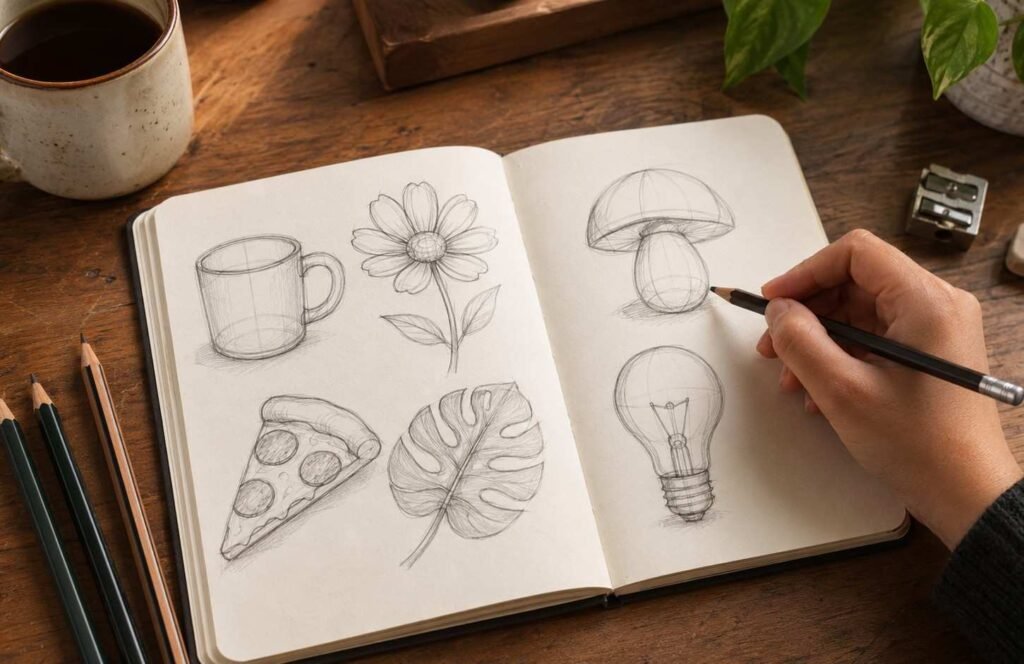
Nature is one of the best places to start because organic shapes do not need perfect symmetry. If your leaf curves differently or your flower petal looks slightly uneven, the drawing still feels natural.
Succulents are great beginner sketches because they use repeated teardrop shapes layered in a circular pattern. Monstera leaves are also fun because you can start with a large heart-like shape, then cut out clean, dramatic sections along the edges. Bare trees help you practice branching lines because you can draw a thick trunk that splits into smaller “Y” shapes.
Wildflowers are another simple option. Start with a small circle in the center, then add repeating oval petals around it. Mushrooms are easy too because they use a soft triangle or dome cap on top of a thick stem. These simple drawing ideas help you practice curves, repetition, and natural texture.
Everyday Objects That Beginners Can Draw Fast
Everyday objects make excellent sketchbook ideas because they are already around you. You do not need to search for inspiration. You can look at your desk, kitchen counter, backpack, or nightstand and find something simple to draw.
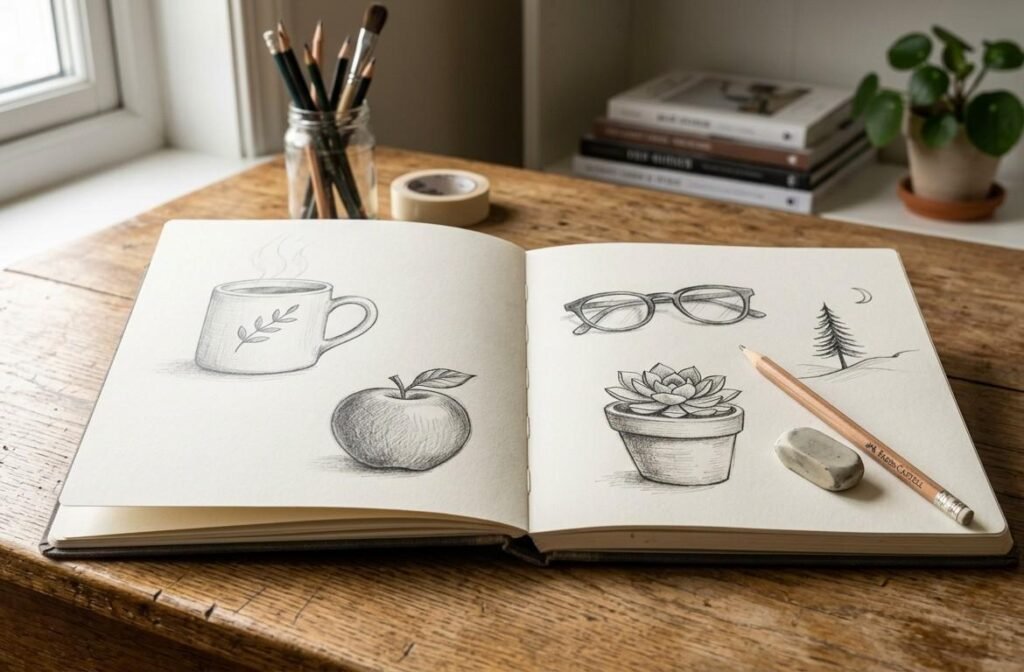
A coffee mug is a perfect first object because it teaches you how to draw a cylinder. Add a curved handle, a few steam lines, and maybe a shadow underneath. Old keys are also interesting because they combine a long rectangle-like shaft with a decorative looped top. A lightbulb works well because it starts as a pear shape with a lined metallic base.
Books are great for practicing stacked rectangles and slightly curved spine lines. An hourglass may look complex, but it is really two connected triangles inside a simple frame. These everyday sketches help beginners understand structure while still creating drawings that look finished.
Cute Food and Drink Sketches for Beginners
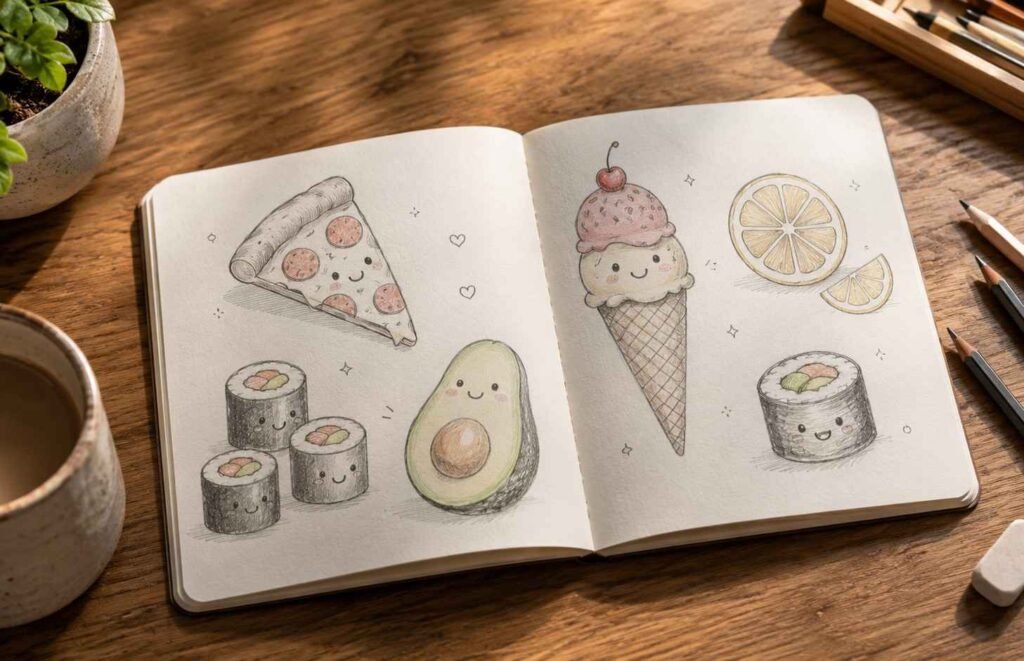
Food is fun to draw because it looks playful, colorful, and easy to stylize. You can keep these sketches simple or turn them into cute doodles by adding eyes and a smile.
A pizza slice starts with a triangle. Add small circle pepperonis, curved cheese lines, and a textured crust. Sushi rolls use small cylinders with concentric circles inside, which makes them perfect for practicing round shapes. An avocado begins as an egg shape cut in half with a round pit in the center.
Ice cream is another beginner’s favorite. Draw a textured triangle cone, then stack overlapping circles or soft scoops on top. Sliced citrus is easy too because you can draw a large circle and divide it into triangle segments. These cute drawing ideas work well for sketchbooks, journals, stickers, and casual doodle pages.
Whimsical Drawing Ideas When You Feel Bored
When you want something more creative, try simple icons with a playful twist. These drawings are still beginner-friendly, but they feel more imaginative than basic objects.
A paper airplane uses sharp connected triangles. A hot air balloon starts with a large teardrop shape and a small basket hanging below it. An origami crane uses angular diamond-like shapes connected together. A campfire uses smooth wavy flame lines over crossed cylinder logs.
One of the most fun ideas is a cat cactus. Start with a standard cactus shape, then add tiny triangular cat ears, dot eyes, whiskers, and small spikes. Whimsical sketches like these make practice feel less serious and help you build your own drawing style.
Step-by-Step Drawing Ideas for Beginners
The easiest way to improve is to draw one subject in small steps. Do not start with details. Start with the largest shape first.
For a flower, draw the center circle, add oval petals, place a curved stem under it, and finish with two leaves. For a coffee cup, draw the top oval, bring two curved lines down, close the bottom, and add the handle. For a cactus, draw one tall oval shape, add two side arms, then place small spikes across the surface.
For a simple landscape, draw a horizon line, add a sun or moon, sketch a few hills, and place small trees in the distance. These step-by-step drawing ideas help you finish a sketch without feeling lost halfway through.
Pencil Drawing Ideas That Build Real Skill
Pencil drawing is ideal for beginners because you can erase, adjust, and shade easily. You can start with light lines, fix the shape, then darken the final outline once it feels right.
Fruit is one of the best pencil subjects. Apples, oranges, pears, lemons, and strawberries help you practice round forms and shadows. A candle teaches you soft shading and glow. A feather helps with thin lines and texture. A sneaker helps you practice proportion and detail.
If you want stronger results, choose one light source before shading. Then shade the side farthest from the light. This simple habit can make even basic sketches look more realistic.
Beginner Tips to Make Your Sketches Look Better
Sketch lightly at first so mistakes erase easily. Heavy lines make correction harder and can make the page look messy too early. I always start with soft, loose marks before committing to darker outlines.
Break every object down into circles, squares, triangles, ovals, cylinders, and rectangles. This one habit can change how you draw almost everything. Also, always embrace imperfections. Your lines do not need to be perfectly straight. Beginner art improves through repetition, not pressure.
Try to draw for 10 minutes a day instead of waiting for a long art session. A small daily habit will help your hand feel more confident and your sketchbook feel less intimidating.
FAQ About Beginner Sketching
1. What are the easiest things to draw for beginners?
The easiest things to draw are objects made from simple shapes, such as flowers, mugs, books, pizza slices, mushrooms, clouds, fruit, candles, and cartoon faces. These subjects help you practice basic structure without needing advanced art skills.
2. What should I draw when I have no ideas?
Look around your room and choose one simple item. A cup, key, plant, snack, phone, shoe, or book can become a quick sketch. You can also pick a theme like food, nature, cozy objects, or cute icons.
3. Are pencil sketches good for new artists?
Yes, pencil sketches are perfect for new artists because pencils are easy to control and erase. They also help you practice shading, outlines, texture, and proportions before moving to ink or color.
4. How do I make easy drawings look more polished?
Start with light construction lines, clean up the outline, add a few details, and use simple shading. Even a basic drawing can look better when you add a shadow, texture, or one clear focal point.
5. What are the best drawing ideas for beginners for daily practice?
The best daily practice ideas include succulents, coffee mugs, fruit, flowers, books, pizza slices, paper airplanes, mushrooms, cactus doodles, and simple landscapes. They are quick, repeatable, and easy to build from basic shapes.
Final Sketchbook Thought
The best beginner drawing habit starts with simple subjects you can actually finish. You do not need perfect talent or expensive supplies. You only need a pencil, a page, and a subject built from basic shapes.
When I use drawing ideas for beginners this way, the blank page feels less scary. A mug becomes a cylinder. A flower becomes circles and ovals. A pizza slice becomes a triangle.
It can also connect naturally with art therapy activities because simple sketching helps you slow down, focus, and express yourself without pressure. Once you see drawing this way, every object around you becomes a possible sketch.